
Labellerr
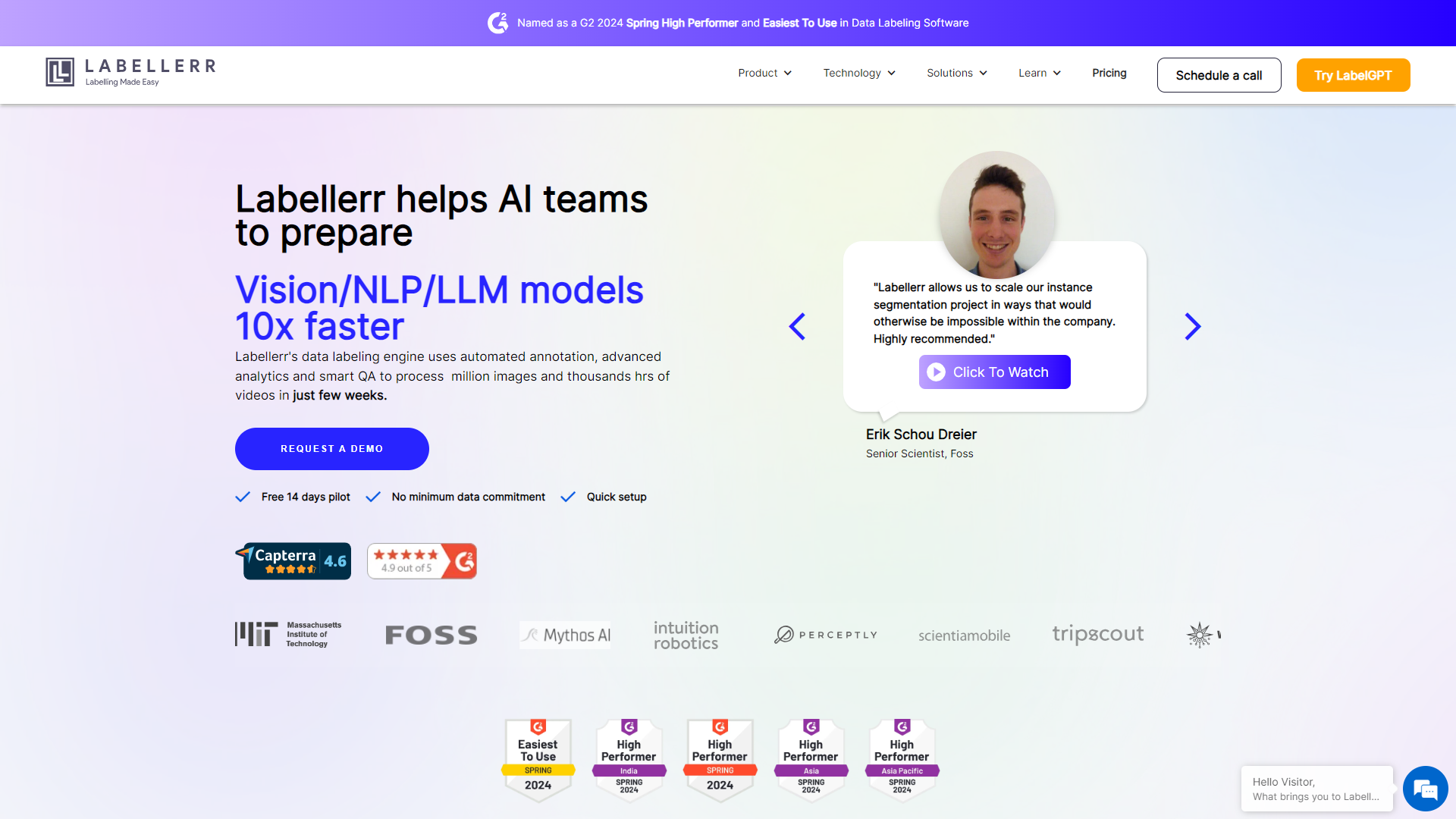
Labellerr is a simple and effective tool for data labeling.
Overview
Labellerr is a powerful data labeling tool designed to help users easily annotate their data. It is perfect for machine learning projects where precise data is crucial. With Labellerr, both beginners and experts can streamline their labeling processes and improve project efficiency.
This tool offers an intuitive interface that allows users to upload data easily and annotate it quickly. The platform supports a variety of data types, making it versatile for different applications. From image recognition to text labeling, Labellerr caters to diverse project needs.
One of the standout features of Labellerr is its collaborative options, which enable teams to work together seamlessly. This fosters better communication and helps ensure that every label is accurate. In short, Labellerr makes data labeling less daunting and more accessible for everyone.
Pricing
| Plan | Price |
|---|---|
| Starter Plan | $49.00 (1 Seats Per Month) |
| Pro Plan | $299.00 (10 Seats Per Month) |
| Enterprise Plan | Contact Us |
Key features
User-Friendly Interface
Labellerr's design makes it easy for anyone to start labeling data without needing extensive training.
Collaboration Tools
Teams can collaborate effortlessly, allowing multiple users to work on the same dataset in real-time.
Multi-Format Support
Supports various data formats like images, text, and videos, which adds flexibility to your projects.
Customizable Labels
Users can create specific labels that suit their project's needs, enhancing the quality of the annotations.
Quality Control
Labellerr includes features to review and validate labels, ensuring high data quality.
Export Options
Data can be exported in various formats, making it easy to integrate with other tools and workflows.
Annotation Tools
Offers a range of annotation tools to make labeling accurate and efficient.
Training Assistance
Provides tutorials and resources to help users learn how to maximize the tool's potential.
Pros & Cons
Pros
- Easy to Use
- Time-Saving
- Great Customer Support
- High Customization
- Frequent Updates
Cons
- Limited Free Version
- Learning Curve for Advanced Features
- Dependency on Internet
- Pricing Can Be High
- Occasional Bugs
Feature Ratings
Based on real user reviews, here's how users rate different features of this product.
Model Development
Supports programming languages such as Java, C, or Python. Supports front-end languages such as HTML, CSS, and JavaScript
Offers the ability for developers to drag and drop pieces of code or algorithms when building models
Provides users with pre-built algorithms for simpler model development
Supplies large data sets for training individual models
Provides users with pre-built algorithms for simpler model development
Supplies large data sets for training individual models
Transforms raw data into features that better represent the underlying problem to the predictive models
Machine/Deep Learning Services
Offers image recognition services
Offers natural language processing services
Offers natural language generation services
Offers artificial neural networks for users
Offers image recognition services
Offers natural language understanding services
Offers natural language generation services
Provides deep learning capabilities
Deployment
Manages the intelligent application for the user, reducing the need of infrastructure
Allows users to insert machine learning into operating applications
Provides easily scaled machine learning applications and infrastructure
Allows users to input models built in a variety of languages.
Allows users to choose the framework or workbench of their preference.
Records versioning as models are iterated upon.
Provides a way to quickly and efficiently deploy machine learning models.
Offers a way to scale the use of machine learning models across an enterprise.
Manages the intelligent application for the user, reducing the need of infrastructure
Allows users to insert machine learning into operating applications
Provides easily scaled machine learning applications and infrastructure
Allows users to input models built in a variety of languages.
Allows users to choose the framework or workbench of their preference.
Records versioning as models are iterated upon.
Provides a way to quickly and efficiently deploy machine learning models.
Offers a way to scale the use of machine learning models across an enterprise.
Management
Records and organizes all machine learning models that have been deployed across the business.
Tracks the performance and accuracy of machine learning models.
Provisions users based on authorization to both deploy and iterate upon machine learning models.
Allows users to manage model artifacts and tracks which models are deployed in production.
Records and organizes all machine learning models that have been deployed across the business.
Tracks the performance and accuracy of machine learning models.
Provisions users based on authorization to both deploy and iterate upon machine learning models.
System
Gives user ability to import a variety of data sources for immediate use
Supports programming languages such as Java, C, or Python. Supports front-end languages such as HTML, CSS, and JavaScript
Offers the ability for developers to drag and drop pieces of code or algorithms when building models
Quality
Gives user a metric to determine the quality of data labelers, based on consistency scores, domain knowledge, dynamic ground truth, and more. 12 reviewers of Labellerr have provided feedback on this feature.
Based on 12 reviewsAs reported in 12 Labellerr reviews. Ensures that labeling tasks are accurate through consensus, review, anomaly detection, and more.
Based on 12 reviewsEnsures the data is of a high quality as compared to benchmark. 13 reviewers of Labellerr have provided feedback on this feature.
Based on 13 reviewsGives user the ability to review and edit labels. This feature was mentioned in 14 Labellerr reviews.
Based on 14 reviewsAutomation
Based on 13 Labellerr reviews. Uses models to predict the correct label for a given input (image, video, audio, text, etc.).
Based on 13 reviewsBased on 13 Labellerr reviews. Automatically route input to the optimal labeler or labeling service based on predicted speed and cost.
Based on 13 reviewsImage Annotation
As reported in 13 Labellerr reviews. Has the ability to place imaginary boxes or polygons around objects or pixels in an image.
Based on 13 reviewshas the ability to detect objects within images. 13 reviewers of Labellerr have provided feedback on this feature.
Based on 13 reviewsAs reported in 13 Labellerr reviews. Track unique object IDs across multiple video frames
Based on 13 reviewsBased on 13 Labellerr reviews. Supports a range of different types of images (satelite, thermal cameras, etc.)
Based on 13 reviewsNatural Language Annotation
Based on 12 Labellerr reviews. Gives user the ability to extract entities from text (such as locations and names).
Based on 12 reviewsGives user the ability to tag text based on its sentiment. This feature was mentioned in 13 Labellerr reviews.
Based on 13 reviewsBased on 11 Labellerr reviews. Gives user the ability to label and verify text data in an image.
Based on 11 reviewsSpeech Annotation
Allows the user to transcribe audio. 12 reviewers of Labellerr have provided feedback on this feature.
Based on 12 reviewsAs reported in 12 Labellerr reviews. Gives user the ability to label emotions in recorded audio.
Based on 12 reviewsOperations
Control model usage and performance in production
Deploy mission-critical ML applications where and when you need them
Easily compare experiments—code, hyperparameters, metrics, predictions, dependencies, system metrics, and more—to understand differences in model performance.
Rating Distribution
Screenshots
User Reviews
View all reviews on G2Incredible solution and support team
What do you like best about Labellerr?
I recently had the opportunity to use Labellerr, to annotate a large corpus of textual data, specifically newspaper articles. My primary objective was to identify key elements within these articles as training data, and Labellerr proved to be an invaluable asset in this task.
Ease of Use: The interface of Labellerr is remarkably user-friendly. I was able to navigate through its features with ease, making the process of annotating large datasets feel less daunting. The intuitive design meant I spent less time figuring out how to use the tool and more time on the actual task at hand.
Efficiency: One of the standout features of Labellerr is its efficiency. The tool is designed to handle large datasets effortlessly. I noticed a significant reduction in the time it took to annotate each article compared to other tools I have used in the past. This efficiency did not compromise the quality of the annotations, which is crucial when working with large volumes of data.
Accuracy: The accuracy of Labellerr is impressive. The tool's advanced algorithms ensured that the key elements in the articles were identified correctly. This accuracy is vital for my project, as it relies heavily on the correctness of the annotated data.
Support and Guidance: The team behind Labellerr deserves special mention. They were always available to offer assistance and guidance whenever I needed it. Their support was not just technical but also advisory, providing insights that helped improve the overall quality of my project.
Overall, my experience with Labellerr has been extremely positive. It stands out for its ease of use, efficiency, accuracy, and excellent customer support. I would highly recommend Labellerr to anyone looking to train large corpora of textual data. It's a tool that truly delivers on its promises.
What do you dislike about Labellerr?
I really can't think of many - this is a product that is growing and I can't wait for them to grow with our orgnization.
What problems is Labellerr solving and how is that benefiting you?
Labellerr is helping us annoate a textual corpus in order to train our machine learning model.
Flexible image data annotation tool I found
What do you like best about Labellerr?
I used Labellerr for one of our projects for image annotations. The software is so easy to use and very flexible. We are using Labellerr for our inspections module, where we take photographs of the Hotel Rooms and mark them for maintenance and other incidents. ...
Labellerr for enhanced online shopping and support: training datasets in action
What do you like best about Labellerr?
Labellerr's Smart Labelling is a game-changer for our diverse data needs, seamlessly covering image, text, and audio annotations. It adapts to tasks like transcribing customer calls and extracting insights from sales rep notes. The in-browser ML models streamli...
Keeping it simple
What do you like best about Labellerr?
I am using Labellerr for mulitple projects, NLP & CV. The ease of use to set up and annotate makes it a breeze to onboard even novices to the team and workflow. The powerful analytics and backend tools as a superadmin give me full control on the Quality of the ...
Easy to use for image annotation task
What do you like best about Labellerr?
Labellerr is easy to use and its UI is quite intuitive. I was able to add my team to collaborate on the project. Apart from that, it supports various data formats, which was very helpful in my case.
What do you dislike about Labellerr?
Sometimes it gives minor...
Company Information
Alternative Mlops Platforms tools


FAQ
Here are some frequently asked questions about Labellerr.
Labellerr is a data labeling tool that helps users annotate various types of data for machine learning projects.
Labellerr offers a free version but has more advanced features available through paid subscriptions.
Yes, Labellerr has built-in collaboration tools that allow multiple users to work on the same dataset.
You can label images, text, videos, and more with Labellerr.
Labellerr provides various export options, allowing you to download your labeled data in different formats.
Yes, Labellerr has a dedicated customer support team that is available to help you with any questions you may have.
The basic features are user-friendly, but advanced features might have a learning curve.
Labellerr regularly updates its software based on user feedback and needs.