BlazeSQL
AI-powered SQL chatbot for simplified data querying.
Overview
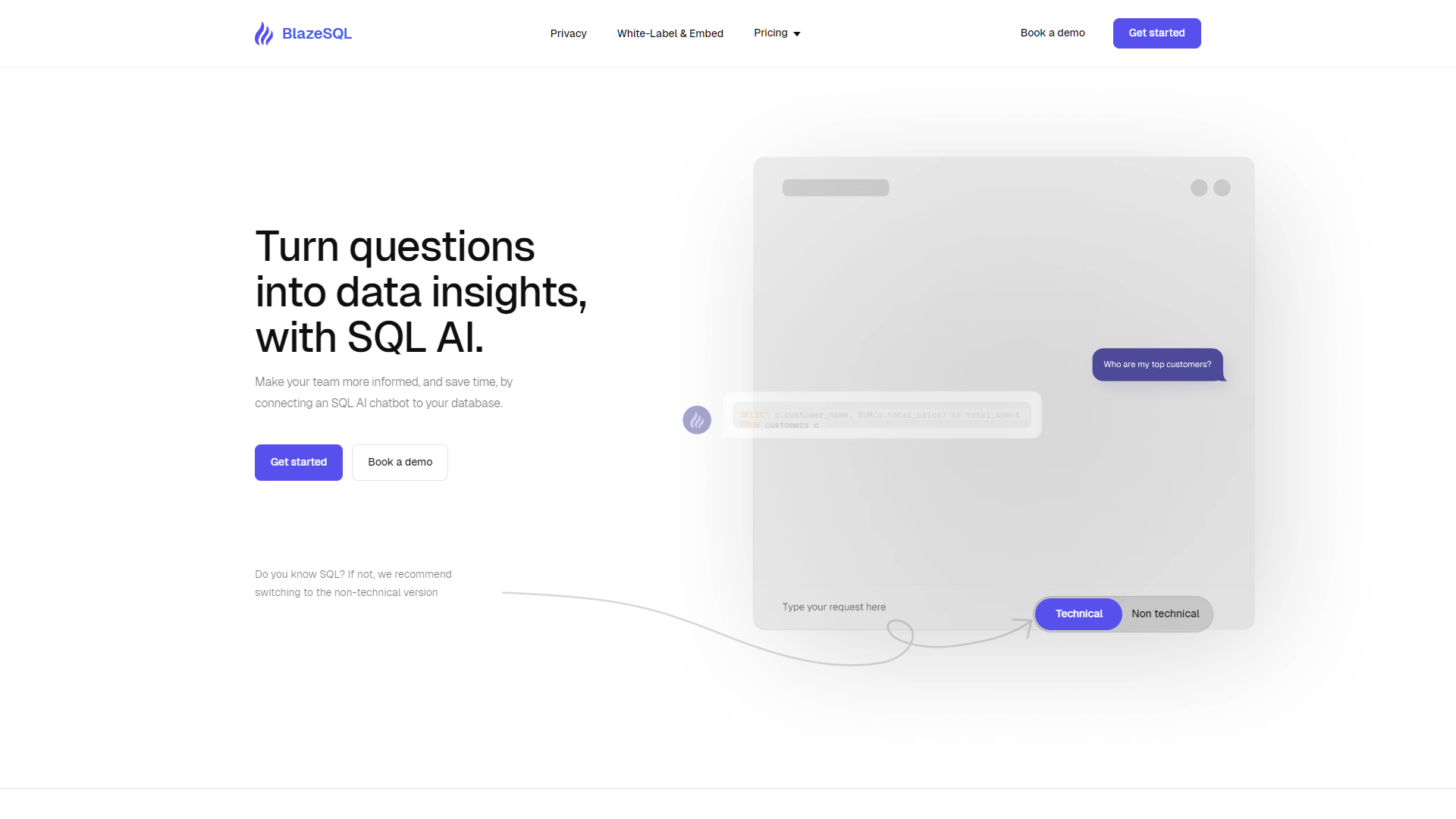
BlazeSQL revolutionizes the way users interact with SQL databases by leveraging AI technology to facilitate natural language communication. This innovative SQL chatbot is designed to cater to both technical and non-technical users, allowing them to execute complex data queries and analyses without requiring extensive SQL knowledge. BlazeSQL supports a variety of database systems, including MySQL, PostgreSQL, and Snowflake, making it a versatile tool for diverse environments.
The platform is particularly beneficial for business analysts, data scientists, and teams who need immediate data insights but want to avoid the complexities of manual SQL coding. BlazeSQL not only generates SQL queries and retrieves data efficiently but also provides visual outputs such as graphs and dashboards to enhance understanding and presentation of data.
BlazeSQL offers multiple pricing tiers, ranging from a basic package suitable for individual users to an enterprise-level plan designed for larger organizations. This scalability ensures that the tool can grow with your business needs. Additionally, the AI-driven system is optimized for query performance and supports rapid data prototyping, which is crucial for agile data operations and complex analytics tasks.
Prioritizing data security, BlazeSQL operates predominantly on local devices, ensuring that sensitive information remains protected. The platform also features customizable dashboards, further enriching its capability as a comprehensive solution for database management and data-driven decision-making.
Key features
Natural language querying
BlazeSQL enables users to interact with databases using conversational language, making SQL queries accessible without extensive SQL knowledge.
Multi-database compatibility
The tool connects seamlessly with various databases including MySQL, PostgreSQL, and Snowflake, facilitating diverse data management needs.
Automated query optimization
BlazeSQL's AI optimizes SQL queries for performance, ensuring efficient data retrieval and processing for faster insights.
Data visualization support
Users can generate visual data representations like graphs and dashboards directly within BlazeSQL, enhancing data analysis and reporting.
Privacy-focused architecture
BlazeSQL prioritizes data security by processing data locally on user devices, protecting sensitive information from external threats.
Scalable pricing plans
With options ranging from individual to enterprise-level plans, BlazeSQL is accessible for various user groups and budget sizes.
Pros & Cons
Pros
- Real-time collaboration
- Extensive API integrations
- Continuous updates and support
- Customizable user interface
- Advanced analytics features
Cons
- Complex setup process
- Limited advanced customizations
- Resource-intensive operations
- Dependency on internet connectivity
- Occasional software updates
Screenshots
Alternative Ai Chatbot tools


FAQ
Here are some frequently asked questions about BlazeSQL.
BlazeSQL is an AI-driven SQL chatbot that allows users to interact with SQL databases using natural language, simplifying data queries and analyses without deep SQL knowledge.
BlazeSQL is ideal for business analysts, data scientists, and teams who require quick data insights but prefer to avoid complex SQL coding.
BlazeSQL offers multiple pricing tiers from a basic package for individual users to an enterprise-level plan suitable for larger organizations.
Yes, BlazeSQL is optimized for query performance and supports rapid data prototyping, making it suitable for agile data operations and complex analytics.
BlazeSQL supports a variety of database systems including MySQL, PostgreSQL, and Snowflake, catering to a wide range of user environments.
BlazeSQL generates visual outputs like graphs and dashboards, which help in better understanding and presenting data effectively.
BlazeSQL operates predominantly on local devices to ensure that sensitive data remains secure and protected from external threats.
BlazeSQL features customizable dashboards, allowing users to tailor the platform to better meet their database management and data-driven decision-making needs.